Market sentiment has been somewhat sluggish recently, especially in the once-hot embodied intelligence sector, where some people feel it's "cooling down" or "gone cold." Let's look at the data to see what's really going on—
IT Juzi data shows that in February 2026, Sequoia China participated in 6 embodied intelligence financing rounds; by October, that number had dropped to 1. Hillhouse Venture Capital also slowed down: it participated in 7 rounds in April, but did not appear on the financing list in October.
Top institutions are indeed making fewer moves, and the financing pace for complete humanoid robots has indeed slowed. But to conclude from this that embodied intelligence is no longer attracting capital attention would be too narrow a view.
According to IT Juzi data, in the first 10 months of 2026, 668 financing rounds occurred in the embodied intelligence field, compared with 287 in the same period of 2025, a year-on-year increase of about 133%. Projects are still getting money; it's just that the heat isn't falling evenly on every institution and every direction.
Humanoid robots are one form of embodied intelligence, not the entirety of this sector. When investors discuss whether robots can enter factories, homes, or other real-world scenarios, what matters is not just the robot's appearance, but also the software and technology that enable it to perceive its environment, understand tasks, and complete operations. This path is broader than building a humanoid robot, and it also takes longer to travel.
Top institutions have slowed down—this is not an illusion
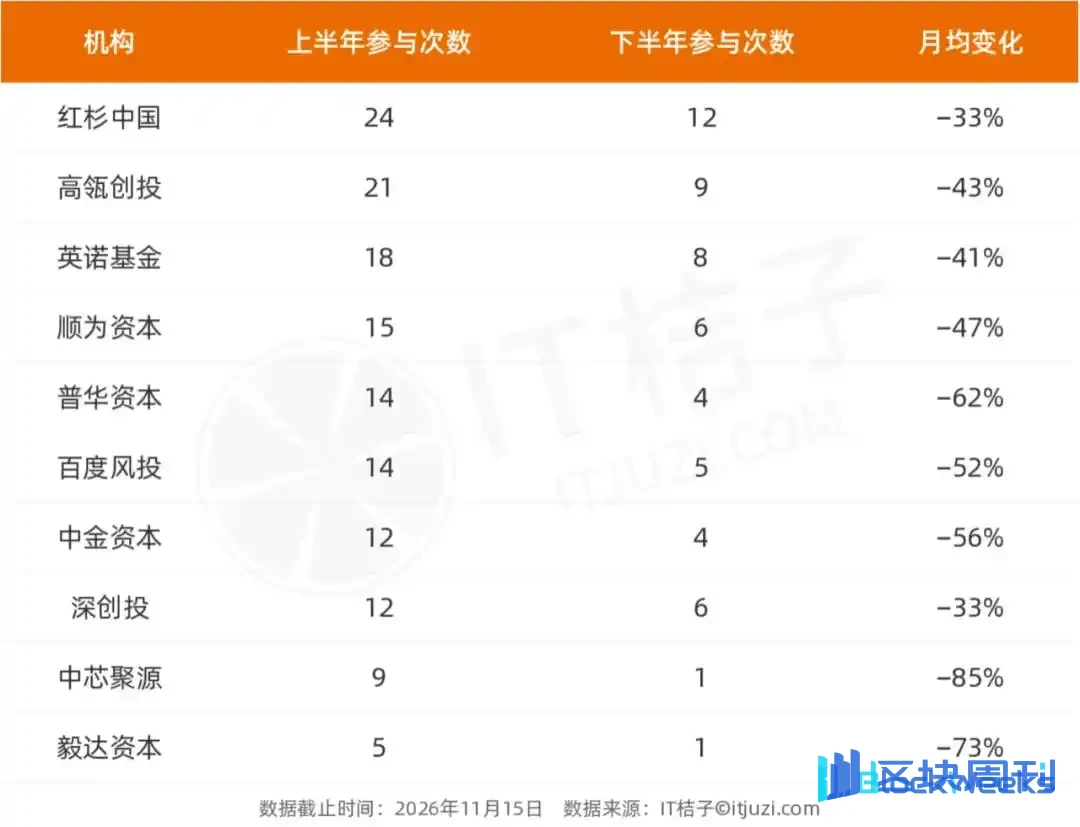
First, look at the investment records of 10 active investment institutions. From the second half of 2026 through November 15, the average monthly participation count of these 10 institutions in the embodied intelligence field was lower than in the first half of the year.
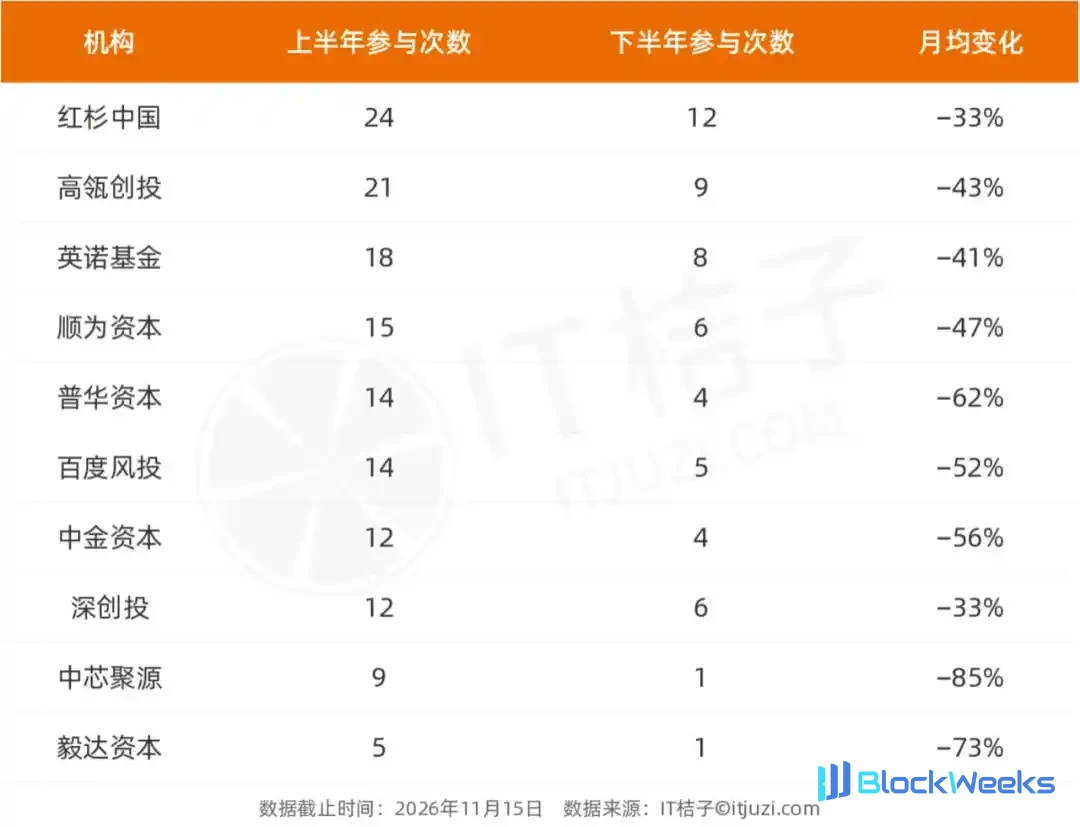
The first half is calculated based on 6 months, and the second half based on about 4.5 months. Sequoia China dropped from participating in 4 rounds per month to about 2.7 rounds, and Hillhouse Venture Capital from 3.5 rounds to 2 rounds. It's not that one institution occasionally took a break: the investment frequency of all 10 institutions declined.
But "making fewer moves" and "exiting the sector" are two different things. What is counted here is the number of times institutions participated in new financing, not how many existing holdings they sold; nor can 10 institutions represent all investors. At least from this sample, top institutions are slowing the pace of investing in new projects, rather than the data having proven that they have left the field.
Zoom out, and the picture is different again. Embodied intelligence saw 365 financing rounds in the first half of the year and 333 in the second half through November 15. Converted to a monthly average, it actually rose from about 60.8 rounds to 74.0 rounds.
A few top institutions slowing down does not mean investment activity across the market has slowed down.
Financing is still happening—it just hasn't been rising all the way
In the first 10 months of 2026, the 668 financing rounds in the embodied intelligence field have already exceeded the 403 rounds in all of 2025. From this perspective, saying capital is "fully withdrawing" does not match the data.
But active financing does not mean every month is hotter than the last. August saw 87 financing rounds, the single-month high in 2026 through October; September and October fell back to 72 and 69 rounds respectively. Investment heat fluctuates; a two-month decline cannot be directly understood as a contraction of the entire sector, nor can past growth be taken as a trend that will necessarily continue.
Fewer humanoid robot financings does not mean all complete machines have cooled
Compared with the sector total, the more obvious change has occurred in humanoid robots.

Converted by the duration of different periods, the average monthly number of humanoid robot financing rounds fell by about 24%. This is not just comparing the March high with some trough: putting the two periods together, the slowdown is equally present.
But complete robots did not cool down along with it. Service robots rose from about 6.3 rounds per month to 10 rounds, and industrial robots also grew. Taken together, the average monthly financing rounds of the four categories of complete machines in the table rose from about 27.8 to 30.2.
This shows that investing in robots does not necessarily mean investing only in robots that look like humans. Service robots and industrial robots are also directions through which embodied intelligence enters real-world scenarios. A few fewer financing rounds for humanoid robots cannot mean that other forms have also lost their opportunities.
Embodied intelligence is more than building bodies—opportunities are extending outward
For a robot to truly complete a task, a movable body alone is not enough. It must recognize its surroundings, understand what to do, and then turn judgment into action. Around these issues, software and AI-related projects are also part of the financing market.

Merged by database sub-industry, the average monthly financing rounds of software and AI-related projects grew by about 40%, faster than complete machines and components. They cover robot software, the AI technology layer, and the AI infrastructure layer, showing that the financing opportunities in this sample are not concentrated only on humanoid robot bodies.
Of course, a higher number of rounds does not mean more money raised, nor can it be concluded from this that capital has fully shifted from bodies to software. Some companies' businesses already involve both software and hardware, and database classifications are not entirely equivalent to product boundaries.
But this change reminds us: when observing embodied intelligence, we cannot just stare at the humanoid robot on stage. Different forms of robots, software, and underlying technologies may all be components of this industry's continued development.
Top institutions have slowed down, but the road has not narrowed
Putting these data together, the answer is not complicated: some top institutions have slowed their moves, and humanoid robot financing has also decreased; at the same time, overall financing activity in embodied intelligence remains active, and other robot forms and software and AI-related projects still have investors.
The road of embodied intelligence is still wide because it is not limited to one kind of robot or one link; the road is also long because moving from technology to different real-world scenarios still requires continuously solving problems of perception, understanding, and execution. Financing counts cannot prove when these problems will be solved, but they show that current exploration has not stopped at any single hotspot.
This article is from the WeChat public account "IT Juzi" (ID: itjuzi521), author: Judy