Tonight (November 19), Anthropic, a company founded less than six years ago, will list on Nasdaq under the ticker ANT. Its speed of development and scale must be called a miracle in the history of technology and business, and it also gives people a glimpse of the enormous impact of AI on the future economy and society.
At a final issue price of $83 per share, its fully diluted valuation is about $1.5 trillion. According to current expectations, its market capitalization after listing may exceed $2 trillion. Seven upstream companies—Google, Nvidia, AMD, Broadcom, Micron, Microsoft, and TSMC—also subscribed simultaneously for $26 billion. Its offering size exceeds SpaceX's $75 billion base offering size in June this year, placing it among the largest listings in U.S. stock market history.
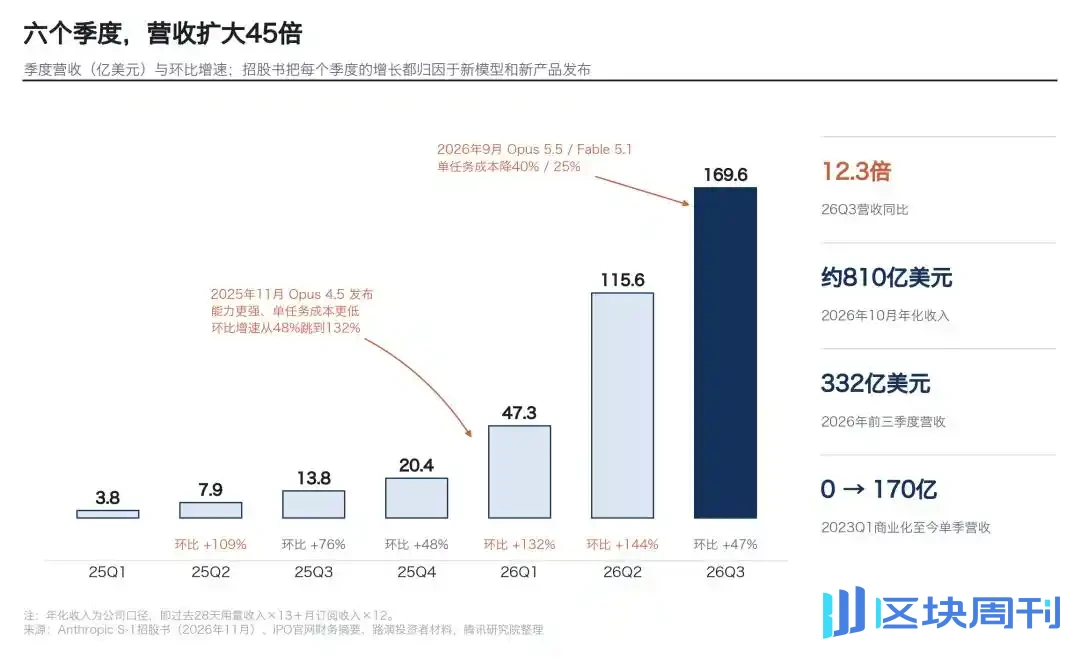
What is more worth looking at than the valuation is its growth curve. This kind of continuous 10x growth far exceeds the high-speed growth of the past mobile internet era, showing the world an astonishing AI acceleration.
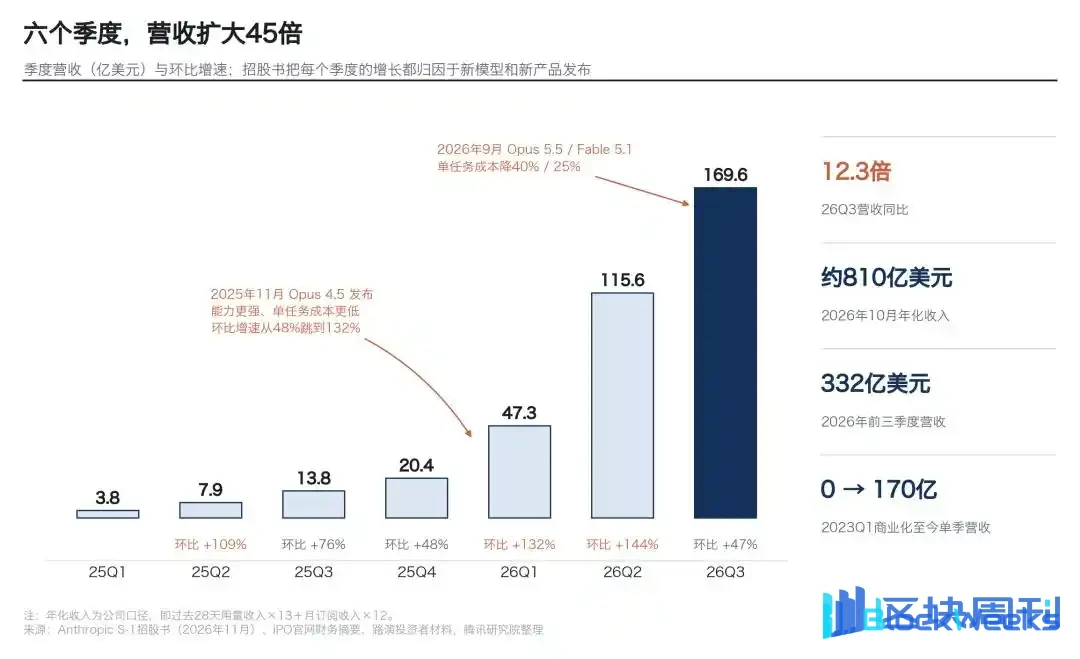
In the first quarter of 2023, Claude began commercialization, with revenue starting from zero. Full-year revenue was $41 million in 2023, $386 million in 2024, and $4.585 billion in 2025. By the third quarter of 2026, quarterly revenue was $16.96 billion, 12.3 times the same period last year. Annualized revenue in October this year has reached about $81 billion, and people predict it may reach $100-120 billion by the end of the year.
On the second page of the roadshow investor materials, there is this sentence: For the first time in human history, intelligence has become something humans can build; the cognitive abilities of reasoning, analysis, synthesis, decision-making, and creation can be produced at scale and obtained on demand. I read this sentence several times. What it is actually talking about is not a company, but a turning point for an industry: for the first time, intelligence begins to exist apart from humans themselves and becomes an industrial product that can be mass-produced, priced, and scheduled.
In particular, the chart below shows Anthropic's ambition. The returns it expects are far more than current revenue from programming, analysis, office work, and so on, but extend to fields such as drug discovery, materials science, advanced manufacturing, and robotics, as well as the $2 trillion life sciences sector, and even the future global $40 trillion knowledge work market. This inevitably reminds us of a controversial rumor in the industry: "In the future, perhaps only Anthropic will remain as a company in the world."
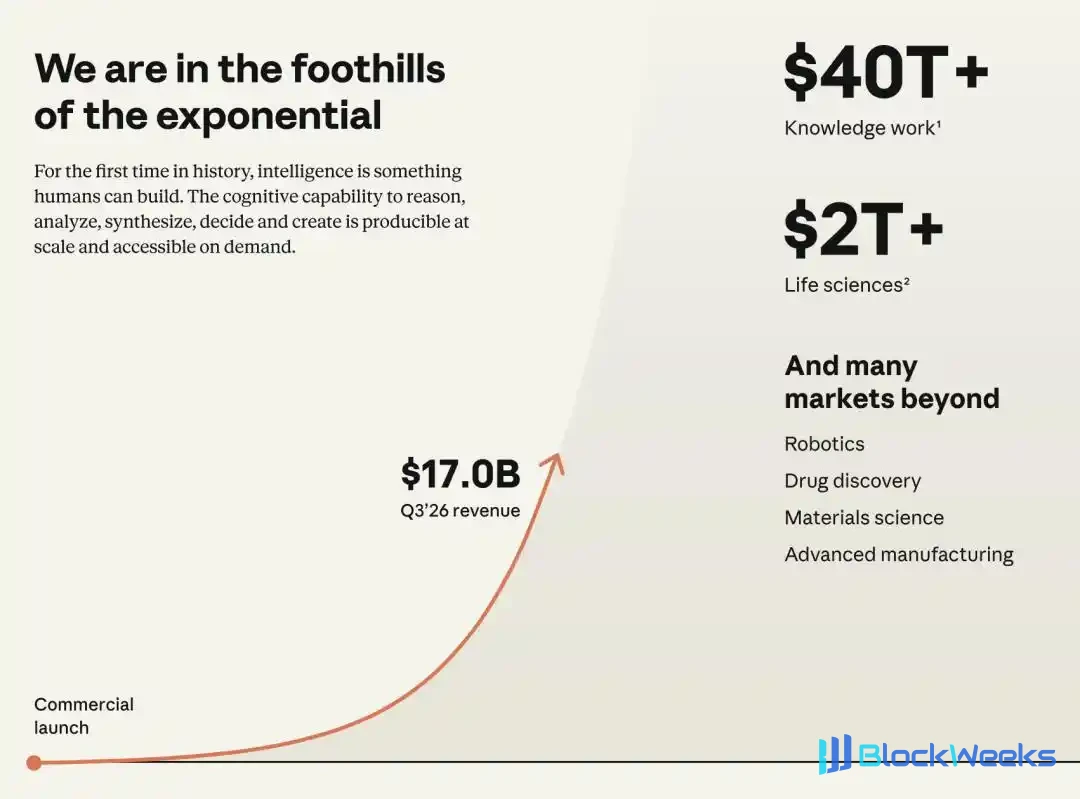
Image source: Anthropic roadshow investor materials
Over the past week, we read together Anthropic's more than 400-page prospectus, 15-page roadshow investor materials, 41-minute roadshow video, and an open letter jointly signed by seven founders. How revenue comes in, where compute is spent, how models iterate, how the organization operates, and how risk is priced have, for the first time, been fully disclosed by a frontier model company. We can see six changes taking place in the large model industry.
Trend 1: Scaling Law is still effective, but the main engine of R&D has switched to AI itself
Among Anthropic's founding team is the lead author of the 2020 paper "Scaling Laws for Neural Language Models." In the founders' letter, it says that at the time many people did not believe machine intelligence would depend so strongly on scale, but predictions based on scaling laws were proven right again and again. The prospectus's judgment is also clear: AI capabilities will continue to improve, and for the foreseeable future, demand will continue to exceed supply, while supply is mainly constrained by compute.
However, after reading the entire prospectus, I think what is more noteworthy than the scaling law itself is three changes in the way R&D is done.
First, post-training has become the area with the largest investment. The prospectus states that post-training has evolved from a finishing step into one of the company's largest areas of research investment, because the market is shifting from conversational assistants to autonomous agents. The training method has also changed, using complete, real, and complex tasks close to professional work. Anthropic believes that the breadth and realism of this task mix are among its most durable scientific advantages, and that it is difficult to observe from the outside, and therefore difficult to replicate.
Second, model architecture and inference infrastructure are designed together. AI researchers and inference engineers share planning cycles, reporting lines, and performance goals, and architecture decisions factor in inference costs from day one. This explains why each generation of Claude can be both stronger and more economical.
Third, and most importantly, AI has begun to participate in building AI, which is also the RSI most discussed right now. Each generation of Claude participates in building the next generation, including running experiments, generating and processing training data, automating evaluation and security audits, and writing and reviewing code.

A few numbers illustrate the point well. In September 2026, more than 90% of commits in Anthropic's codebase were written by Claude; in the third quarter, the amount of code contributed per engineer per day was more than 45 times the 2024 daily average. On open-ended engineering problems that lack clear specifications and previously relied heavily on senior engineers' judgment, according to the company's internal benchmarks, Claude's success rate rose by about 50 percentage points in nine months, reaching about 90%. When integrating AMD chips this year, Claude completed the adaptation basically without human intervention within three days, porting or writing almost all operators, which previously required dozens of engineers and several months.
At list prices, the value of Anthropic's internal use of Claude grew more than 250 times from January to September this year. In April this year, this monthly value exceeded the company's monthly personnel expenses (excluding stock-based compensation) for the first time.

Image source: Anthropic roadshow investor materials
There is also a trade-off that is easy to overlook. The prospectus clearly states that although video and image generation models have commercial appeal, the company is currently not focused on them, and the corresponding compute is redirected to programming, agents, and safety research. There are three reasons: programming has a large economic impact; safety issues will surface here first; and the output of programming is largely verifiable.
The key to winning in large model competition is shifting to the speed of the R&D loop. Whichever company's model can first do its own company's work well will have its next-generation model arrive sooner. Verifiable domains will be conquered first and will also feed back into R&D first.
Of course, this loop has another side. The prospectus specifically mentions that using AI to accelerate AI will bring considerable safety risks, and the company's responsible scaling policy already includes monitoring and mitigation plans for approaching recursive self-improvement. The founders' letter puts it more directly: if necessary, the company may proactively slow down.
Trend 2: Products Are Moving from Chat Boxes to Virtual Collaborators, Delivering Work Rather Than Answers
The founder's letter contains a judgment about product generations: AI chatbots became usable around 2022, AI coding agents around 2025, and agents for general knowledge work and scientific discovery are gradually becoming usable in 2026. The letter also says that Anthropic will spend less effort consolidating existing products and more effort defining new products, because each new generation of models keeps opening up product categories that were not feasible just a few months earlier.

The prospectus gives this generation of products a name: virtual collaborators. They have permissions granted by the organization, system connections, and context; they can use internal tools; they can execute workflows that span multiple steps and require sustained reasoning; and they work side by side with employees.

Image source: Anthropic roadshow investor materials
Programming was the first category to cross the threshold. Claude Code was released as a research preview in February 2025. In about a year, Claude went from suggesting single lines of code to operating clusters of agents that work autonomously in production codebases. The prospectus compares the impact of Claude Code to the first widely adopted conversational AI assistants. Usage is often unexpected; for example, NASA engineers used it to plan and write navigation commands for the Mars Perseverance rover, completing the first AI-planned drive on Mars.
Cybersecurity may be the second. On a vulnerability exploitation benchmark developed by Carnegie Mellon University researchers, Claude's score rose from 40% to 78% and then to 91% in about four months.
Knowledge work is the third. One sentence in the prospectus left a deep impression on me: all digital work is ultimately a form of code expression. Based on this judgment, Anthropic ported Claude Code's agent architecture to knowledge workers and built Cowork, which autonomously reads files, operates applications, and executes multi-step workflows on the user's desktop, with the underlying code hidden. Cowork was released as a research preview in January 2026, and by the end of September its adoption rate had already surpassed Claude Code's level at the same point in time. In September, Cowork began merging with Claude.ai, allowing users to transition directly from a simple question to a complex multi-step task within the same conversation.
Conversation and agents are merging into the same product.
Customer cases confirm this as well. Rakuten used Claude Code to achieve more than 7 hours of autonomous programming, shortening the time to launch new features from 24 working days to 5; Salesforce completed an API migration that originally required 231 days in 13 days; Bristol Myers Squibb enabled Claude for all 30,000 employees, shortening the response time for an epidemiology question from one or two months to four or five minutes.
As the product form changes, the technology stack must change with it. There is a very plain sentence in the prospectus: a model alone does not constitute an agent. Agents must be able to recover from crashes, operate systems with scoped and auditable credentials, and scale under variable loads; all of this requires a runtime framework. Anthropic opened up the same runtime framework that powers Claude Code as the Agent SDK and also launched a hosted version, Managed Agents; together with the skills package Agent Skills, the MCP protocol that connects enterprise data and tools, and the model hardware standard MHS that lets agents operate laboratory and manufacturing equipment, these form the middle platform layer.

Doing all three layers together—models, platform, and applications—is already showing benefits in customer data. As of the end of September this year, among customers paying more than $100,000 annually, more than half were using both the platform and at least one first-party application; in the fourth quarter of last year, this proportion was about 30%.
The product unit of large models is shifting from a single answer to a delivery. The focus of competition will shift from model benchmarks to engineering capabilities such as runtime frameworks, context management, permission systems, and tool connections—what people often call the Harness. Another approach worth learning from is that Anthropic designs products around the capabilities models will have, rather than around current capabilities. That is how Claude Code was built, so once the capability arrived, the product could rapidly scale.
Trend 3: Paying for Intelligence, with Models Having a Shelf Life Like Fresh Produce
Anthropic calls its main revenue model pay-for-intelligence, meaning usage-based billing, measured in tokens and priced according to the selected model. In the first three quarters of 2026, usage-based billing accounted for 79% of revenue and subscriptions for 21%; revenue through the three major cloud platform marketplaces accounted for 44%; revenue outside the United States accounted for 29%.

Three details are especially illustrative of the characteristics of this model.
First, price cuts are trading price for volume, not a price war. In November 2025, Anthropic released Opus 4.5, which was more capable and had a lower price and lower per-task cost. After that, the company's quarter-over-quarter revenue growth jumped from 48% in the fourth quarter of last year to 132% in the first quarter of this year. Opus 5.5, released in September this year, reduced the cost for customers to complete the same tasks by about 40%; Fable 5.1 reduced it by about 25% compared with the previous generation, and could save up to 45% on complex programming and highly agentic tasks. According to the roadshow disclosure, in the third quarter about $600 million less was collected because of price cuts and contract discounts, but this was fully offset by usage growth. Management's statement is that this price cut was neutral to margins because the new models themselves are more compute-efficient.
In other words, behind the decline in token unit price is an efficiency dividend: compute efficiency must rise first before prices can come down, and price cuts in turn further release demand.
Second, models have a shelf life. The prospectus discloses that in the third quarter, more than 80% of revenue came from model versions released within the past six months. In the first three quarters of this year, the company launched a total of 250 new model versions, platform features, and applications. In this industry, a model is not software developed once and sold for a long time; it is more like fresh produce that needs constant restocking. Whoever stops will see customers migrate to someone else's latest model.
Third, revenue follows the rhythm of people's work. The prospectus mentions that in the two weeks ending January 2 this year, total customer spending fell by about 20% compared with the previous two weeks, because many companies scheduled code freezes during the holidays, and developers slowed down code commits and feature launches. The revenue of an AI company is beginning to show seasonality similar to that of the human services industry. This indirectly shows that Claude has become deeply embedded in real production activities.
There is one more commitment worth mentioning: Claude does not run ads. The founder's letter says that advertising would likely be a substantial source of revenue, but once advertising enters revenue targets, pressure to pursue user time spent would rise, and the company wants Claude's only incentive to be giving users a useful answer. The revenue model determines the incentive direction of the product, and this applies to all companies building agents.
The pricing unit for large models is shifting from seats to tokens, and the next step may become tasks and results. Whoever can continuously lower the cost per task will be able to capture demand elasticity; and whether the cost per task can be lowered depends on the compute efficiency discussed below.
Trend Four: Enterprises Are the Main Battleground, Developers Are the Entry Point, and Delivery Capability Is the New Bottleneck
Anthropic has focused on enterprises from the very beginning. The founder's letter reasons that the enormous value of AI mainly comes from how enterprises and organizations deploy it.

The numbers are growing fast. Customers paying more than $100,000 annually numbered about 20 at the end of 2023, about 200 at the end of 2024, more than 950 in September 2025, and more than 11,900 by the end of September this year, a 12-fold increase in one year. Among them, more than 1,900 pay more than $1 million annually, and about 250 pay more than $10 million. Net revenue retention is about 900%, meaning that customers who were already paying a year ago spent about 9 times as much this quarter as in the same period a year earlier.
The customer structure is also becoming healthier. Revenue from the top five customers fell from 36% in the first quarter of this year to 21% in the third quarter, with no single customer accounting for more than 10%.
What is more noteworthy is that there is still a lot of room. More than half of the Fortune 500 are already customers paying more than $100,000 annually, but these customers' average spending on Claude is less than 0.1% of their total expenses; even the top ten spenders are below 1%. The prospectus states verbatim that the gap between what Claude can do and how widely it is used is one of the company's biggest growth opportunities.
How is the money spent? The roadshow describes the typical path in four steps: engineers first use Claude Code, then expand to adjacent roles, then enter business processes, and finally embed it into external products. The prospectus gives a comparison: in the third quarter, enterprise users who did not use Claude Code spent an average of less than $75 per month, while the top 5% of users who used Claude Code spent about 20 times that amount. Developers are both the most demanding early users and the most persuasive promoters within enterprises.
But bottom-up alone is not enough. The prospectus candidly admits that a major obstacle to Claude's adoption is the natural resistance to change within organizations. To this end, Anthropic has built a complete delivery system: direct sales teams and applied AI teams organized by geography and then by industry, working with customers to design and deploy customized solutions; joint sales with the three major clouds AWS, Google Cloud, and Azure, with customers signing directly with Anthropic and Anthropic paying the cloud providers; system integrators such as Accenture, Deloitte, KPMG, and PwC have set up dedicated Claude business teams; the partner network has certified 150,000 practitioners from more than 4,000 organizations; in October, it invested another $100 million to establish an academy, planning to train 10,000 FDE engineers by the end of 2027 to the standard of its own engineers, capable of advancing AI into production environments; it has also partnered with private equity firms to establish an AI services company specifically serving mid-sized enterprises.
Even so, in the first half of this year, sales, marketing, and partner expenses accounted for only 19% of revenue.
Model capabilities have already run ahead of organizations' absorptive capacity. The bottleneck for enterprise AI in the next stage is not the model, but delivery: FDE engineers, application teams, and ecosystem partners who can connect models into real business processes will become the scarcest resources. This is the same phenomenon as our earlier observation that on-site delivery engineer positions grew 15-fold in a year.
Trend Five: Compute Is the Biggest Cost and Also an Intertemporal Futures Contract
First, look at efficiency. From the first quarter of 2025 to the third quarter of 2026, Anthropic's revenue expanded 45-fold, while compute and infrastructure spending expanded only 10.4-fold. Revenue generated per $1 of compute spending rose from $0.40 to $1.72, and once reached $2.08 in the second quarter.

Image source: Anthropic roadshow investor materials
The company gives two reasons. First, algorithmic improvements multiply compute, so the same model can be trained and run with less compute. Second, multi-chip architecture: training and inference simultaneously on Amazon Trainium, Google TPU, Nvidia GPU, and AMD GPU, with all compute treated as a single interchangeable resource pool and dispatched uniformly, moving compute to wherever marginal output is highest. The aforementioned three-day integration with AMD is the result of this capability combined with the closed loop.
Next, look at mismatch. The prospectus states that the company typically purchases compute 12 to 18 months in advance, and this portion of cost is basically fixed in the short term, while demand doubles quarter by quarter.

The result is that profits swing sharply with demand forecasts. In the second quarter, revenue outperformed the compute ordered more than a year earlier, compute spending accounted for only 48% of revenue, and operating profit turned positive for the first time among disclosed quarters, with an operating margin of 8%. In the third quarter, demand continued to surge, and the company bought $5 billion of short-term compute at high prices, with unit prices significantly higher than multi-year contracts, accounting for about half of that quarter's compute spending; the compute share rose back to 58%, and the operating margin turned to negative 3%.
There is another set of figures worth comparing. According to the roadshow basis, the gross margin for the first three quarters of this year was 85%, but if all compute spending including model training is deducted, the margin is only 43%. Gross margin only counts the portion of compute serving customers; compute for training the next generation of models is not included. For large model companies, the truly largest cost is precisely outside gross margin.
Finally, look at scale. As of the end of September and thereafter, Anthropic's signed compute and infrastructure commitments total about $900 billion, of which about $451.6 billion will occur before the end of 2030, and the rest mainly between 2031 and 2045. About $70.7 billion matures in the next 12 months, lower than the current annualized revenue of about $81 billion; but the portion before the end of 2030 is already 5.6 times the current annualized revenue.

To gain more room to maneuver in this intertemporal game, Anthropic is shifting more compute to its self-built system Anthropic Direct: renting chips itself and putting them into dedicated data centers built to its own specifications. Its cleverness lies in separating two things: data center construction takes a long time but accounts for only a small part of total cost, so it can be locked in first; chip investment is large in amount, so the company can wait until demand is clearer before deciding how much to buy. Management's long-term target is to reduce compute spending to 45% to 50% of revenue, with adjusted operating margin exceeding 35%.
The founder's letter is very candid about this: the company often makes forward-looking investments that at first glance look irresponsibly large, especially in compute. The letter uses the pharmaceutical industry as an analogy: early R&D investment is huge, and the accounts only work out once a successful drug emerges, except that this process is faster and larger in scale for AI. At the same time, the company is willing to give up some upside in exchange for downside protection, such as reselling excess compute when demand is overestimated, continuously improving efficiency to increase tolerance for misjudgments, and raising financing in advance when necessary. In the words of the letter, be bold, but clear-headed.
The core operating capabilities of large model companies have begun to become demand forecasting and compute scheduling. To judge a heavily invested AI company, first look at its output curve per unit of compute, then look at whether the term of its compute contracts matches its demand growth rate. The former determines whether it can make money; the latter determines whether it will be crushed by compute costs in some quarter.
Trend Six: Security and governance, from cost center to part of the product
In April this year, Anthropic trained Mythos, the most capable model at the time, and judged that its ability to discover network vulnerabilities was too strong, so it did not open it fully and directly. Instead, through a program called Project Glasswing, it provided only a restricted research preview to some institutions for cybersecurity defense, while giving defenders about $100 million in usage credits. Only after additional security safeguards were put in place did the company fully open it in June under the name Fable 5. The founders' letter acknowledged that this delay meant giving up considerable revenue and also ceding part of its competitive position.
Is this commercially worthwhile? The prospectus's answer is: strict security safeguards, predictable model behavior, and provable accountability mechanisms have become the decisive criteria for enterprises choosing AI partners for mission-critical tasks. Well-aligned models are better at following instructions, will not rashly take destructive actions before clarifying user intent, and are more resistant to prompt injection attacks. When models begin to connect to critical business systems as agents, security is reliability, and reliability is whether it can be sold.
To this end, Anthropic worked with more than 100 customers in finance, healthcare, and the public sector to develop enterprise-grade frontier security safeguards: monitoring data is stored in the customer's own cloud account, encrypted with the customer's keys, and abuse alerts are sent directly to the customer's security team, without Anthropic employees handling them.

In terms of governance, Anthropic is a Delaware public benefit corporation, and its board must weigh shareholder interests against its public benefit mission. Power is shared among three parties: the seven co-founders hold a fixed 50.1% voting power through one Class F share and elect 3 directors; a long-term benefit trust with no financial interest in the company elects 4 of the 7 directors, one of whose nomination and removal has a protection mechanism, and when the company and the trust disagree, employees vote. The founders' special voting rights are not permanent; when fewer than 3 founders remain in the voting entity, they revert to ordinary shareholders.
The public benefit arrangement is also written into the equity: before listing, 5% of equity was set aside to establish a public benefit fund, and thereafter, for every sustained 50% rise in the stock price, the board may set aside another 2%. All seven co-founders have pledged to donate 80% of their personally held equity, and more than half of employees have also pledged to donate part of their equity.
There is a passage in the founders' letter that I think is the most sober part of the entire listing document. They said that before launching the IPO, they consulted many entrepreneurs who had been through listings, and several gave similar advice: never let your company be worth one dollar more than its actual value. Because it is very dangerous when people buy shares based on expectations you cannot fulfill, or misjudge how you will act. So this letter specifically sets out two types of decisions in which the company may deviate from investor expectations: one is business bets that arise from exponential AI development and look somewhat abnormal on their own, and the other is choices that deviate from profit maximization in order to balance the public interest.
Security is also the adhesive that helps Anthropic attract talent. All seven co-founders are still employed, the unexpected attrition rate is about 1%, and of the employees the company hoped to retain but who left, 19% later returned; more than three-quarters of the first 100 employees are still at the company.
When models change from answering questions to acting on people's behalf, trust becomes the product feature itself. Security investment is no longer just a compliance cost, but is paying for access to enterprise customers' critical business.
Four uncertainties in the prospectus also deserve attention
First, growth is bound to slow. Third-quarter sequential growth was 47%, significantly lower than 144% in the second quarter. The prospectus itself states clearly that revenue growth will decline over time, and the decline may be larger and come sooner than expected; as growth slows, seasonal fluctuations will become more pronounced, and performance will be harder to predict.
Second, revenue quality. The prospectus discloses that about 5% to 7% of revenue in the first nine months of this year came from customers later determined to have violated usage policies or commercial terms. The company strengthened detection and enforcement in August and September, and this portion of revenue will gradually decrease, but how large the impact on growth will be and when it will show are currently uncertain.
Third, compute mismatch. Commitments of about $900 billion generally must be fulfilled regardless of revenue and utilization. Part of the compute buildout also relies on funding or credit support provided by cloud vendors and chip partners. Amazon and Google are both major shareholders with stakes of more than 5%, while also being customers, distribution channels, and competitors; this multiple relationship is itself a source of uncertainty.
Fourth, book losses. The third-quarter net loss was $23.3 billion, of which $21.9 billion was fair value changes in convertible notes, derivative liabilities, and SAFEs brought about by valuation increases, which are non-cash items; but equity incentive expenses recognized successively after listing will still continue to weigh on the income statement. On competition, OpenAI, Google, and increasingly capable open-weight models are all on the same track.
From the perspective of issue pricing, the market is in fact already doing this math.
Five insights for the large model industry
Putting the six trends together yields five insights for the industry.
First, in R&D, become the first user of your own model. Anthropic's closed loop shows that the depth of internal use determines iteration speed more than rankings on external leaderboards. Start with domains where results are verifiable, such as code, let the model first transform your own R&D process, and then spill this capability over to customers.
Second, in products, shift from conversation to delivery. Models, runtime frameworks, connection protocols, and skill packages must be built together, and products should be designed around delivery outcomes rather than answer quality; at the same time, plan products around the model's capabilities six months from now, rather than focusing only on current capabilities.
Third, commercially, treat output per unit of compute as the first operating metric. The model of usage-based billing plus continuous price cuts presupposes a continuous decline in per-task cost. Price cuts without efficiency gains are just subsidies; price cuts supported by efficiency gains can bring demand elasticity.
Fourth, in the market, enterprise services depend on the delivery system. Bottom-up penetration by developers, deep delivery by applied AI teams, ecosystem coverage by cloud platforms and integrators, FDE engineer certification and training, plus service forms aimed at mid-sized enterprises—none can be missing. When model capabilities are in excess, whoever can turn capabilities into results in customer processes can capture revenue.
Fifth, in compute, heterogeneous compute pooling and a mix of long- and short-term contracts are basic skills. Whether a model company can efficiently train and infer on multiple chips, whether it can use AI to automatically complete operator migration, and whether it can lock in data centers and chips separately and pair long-term contracts with short-term ones directly determine its profit elasticity when demand fluctuates. For enterprises that need to run models on multiple chips at the same time, this is especially instructive.
Finally, back to that sentence: never let your company be worth one dollar more than its actual value.
The significance of Anthropic's listing is not that there is another trillion-dollar company, but that for the first time the large model industry must accept quarterly reconciliation by the public market. After intelligence begins mass production, what is harder than making smarter models is continuously proving that someone is willing to pay by usage for the intelligence obtained from each unit of compute.
This exam begins with the market opening tonight, November 19.
(This article is based on Anthropic's publicly disclosed prospectus, roadshow investor materials, roadshow videos, and founders' letter. The company's self-reported operating data and management roadshow statements have not been independently verified; the issue price and size are subject to final pricing and do not constitute any investment advice.)
Wang Qiang, Director of the Frontier Technology Research Center at Tencent Research Institute
This article comes from the WeChat public account "Tencent Research Institute" (ID: cyberlawrc), author: Wang Qiang