






Original | Odaily Planet Daily (@OdailyChina)
Author | Wenser (@wenser 2010 )

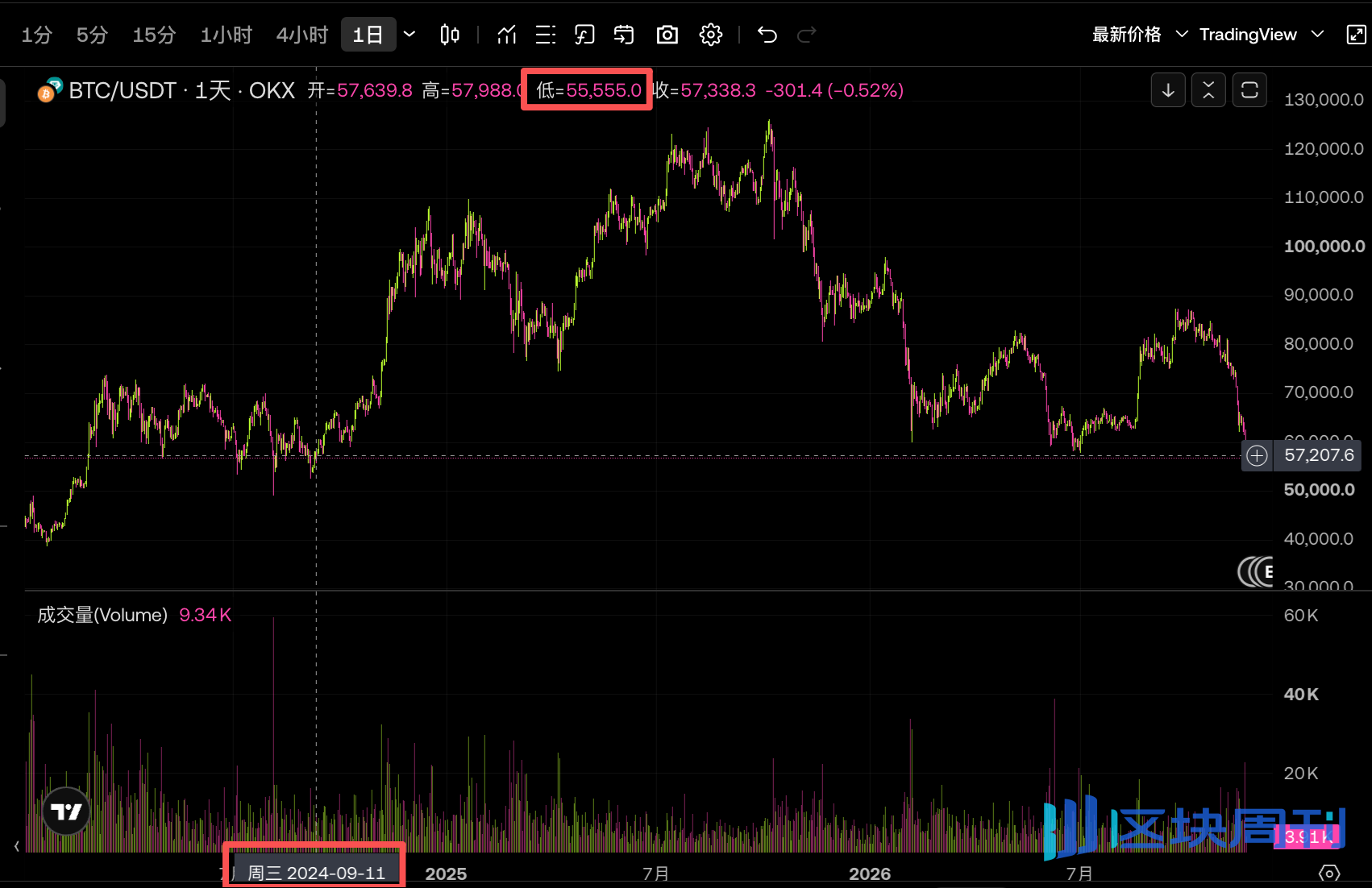
On September 11, 2024, when BTC fell below $56,000, the crypto market fell into panic, and the saying that "falling below $50,000 is not a dream, and falling to $30,000 is also possible" began to spread gradually. But soon, as Trump was elected President of the United States, with a series of favorable factors, BTC took 1 year to hit a historic high of $126,000.
On July 1 this year, when BTC fell below $58,000, the crypto market once again fell into panic. The difference is that at that time, global stock markets were in a bull market driven by the AI boom, and gold's performance was slightly short of its high at the beginning of the year, but still decent. The rest of the story, everyone knows: the Federal Reserve raised interest rates, AI concept sectors collectively sold off, and many funds had to reduce leverage to relieve pressure.
Today, as BTC once again falls below $56,000, stocks, gold, and bonds are all declining across the board at their lowest. The opening bell of Anthropic's IPO seems to have sounded the alarm for the "AI bubble," and the crypto market, the stock market, and even gold, which has traditionally been regarded as a "safe-haven asset," have not been able to stay out of this decline. What exactly happened in the market? Is an economic crisis really coming? Odaily Planet Daily will sort out and discuss the relevant situation in this article.
Behind the Global Selloff: Rate Hike Expectations, AI Slowdown, and ETF Redemptions
In the current broad decline, U.S. tech stocks, AI-related trades, gold, and crypto assets are all weakening at the same time. This is not a safe-haven move in a certain market or sector, but more like a collective liquidation of liquidity in risk assets.
The Dark Cloud of Fed Rate Hikes: The Biggest Macro Driver of the Market Decline
At the macro level, the market is still digesting where the Federal Reserve will raise interest rates next. At the October policy meeting, the Federal Open Market Committee (FOMC) ultimately kept interest rates unchanged with 10 votes in favor and 2 against, but the dissenting governors Lisa Cook and Cleveland Fed President Beth Hammack both advocated a 25-basis-point rate hike on the spot. Subsequent meeting minutes pointed out that in order to bring inflation back to the 2% target in a timely manner, it may be appropriate to continue raising the target range for the federal funds rate next. Two participants also mentioned that if subsequent inflation data is poor, a rate hike of more than 25 basis points could be considered at the next meeting.
Federal Reserve Governor Christopher Waller put it more directly: "Inflation is moving in the wrong direction, and it is spreading. The Federal Reserve may need to shock the market with a 50-basis-point rate hike at the December 8-9 meeting." His exact words were: "You might need to, like, shock people."
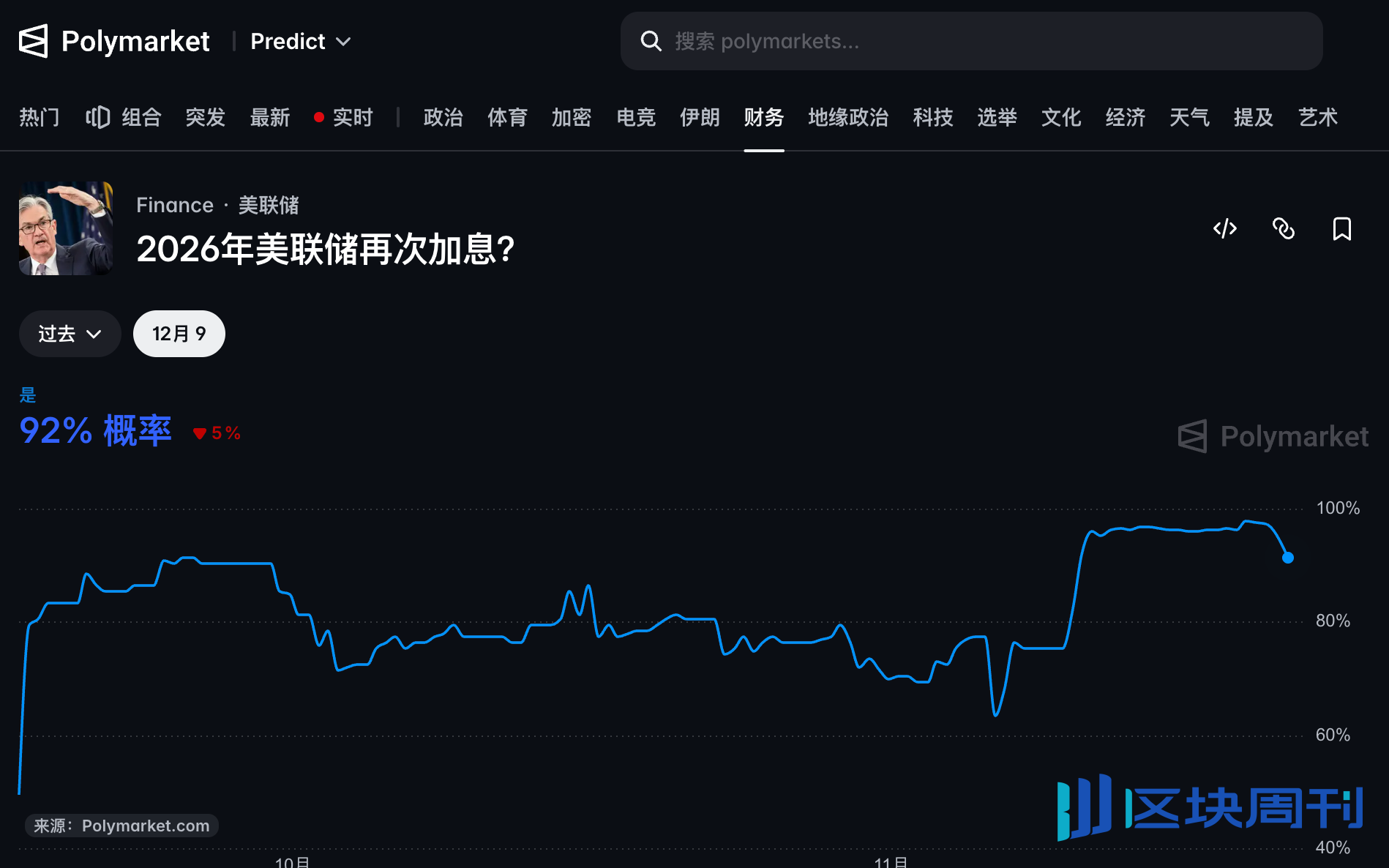
Although New York Fed President John Williams and U.S. Treasury Secretary Scott Bessent opposed this, the probability of a rate hike in December is still relatively high, and the market has already begun to price it in advance. On PolyMarket, the probability of the event "the Federal Reserve raises rates again in December" has risen to 92%.
AI Pullback: Semiconductor Sector, Crypto Miners, and Crypto Assets Are the Biggest Losers
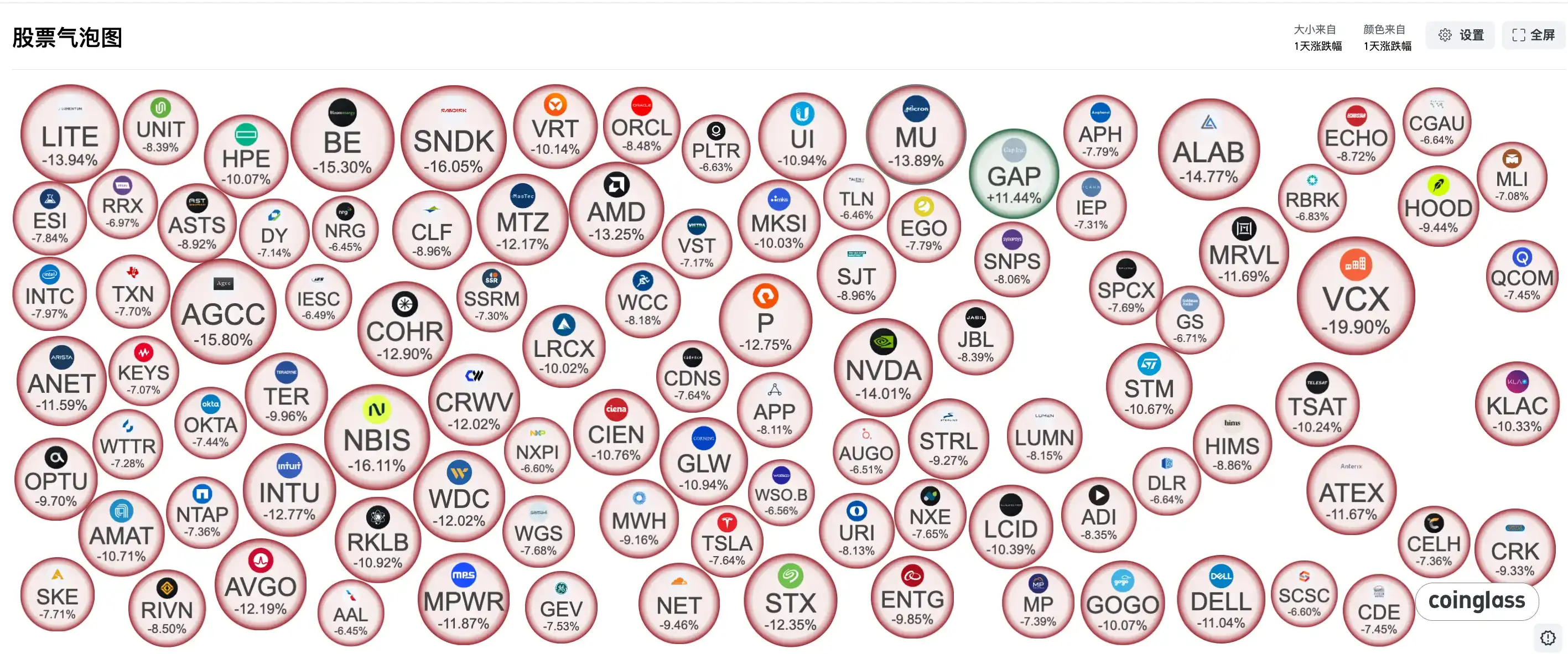
The reflexivity of the market is that when everyone expects something to be bullish, it may instead be bearish, just like Anthropic's IPO. After listing under the ticker ANT, Anthropic's stock price surged intraday and then quickly fell, once approaching the issue price of $83 and nearly breaking issue. Its fundraising of more than $100 billion (IPO and commitments from 7 major companies) also drained liquidity from the capital market to the point of exhaustion, sucking blood even more than SPACEX's listing in August this year.
Affected by this, the semiconductor ETF (SOXX) fell 8%, and the Nasdaq Composite Index fell 3.8%, both returning to their weakest levels since April. In addition, considering external factors such as the Democratic Party winning majority seats in both chambers of Congress and the "AI central bank" Nvidia's leadership change turmoil involving founder Jensen Huang, the Bitcoin mining sector, which is deeply tied to the AI data center narrative, was another hard-hit area: Hut 8 fell nearly 15% that day, while Core Scientific, CleanSpark, and Bitdeer fell more than 13%. Gold also fell another about 2%, approaching $3,500 per ounce. On the crypto asset side, ETH, XRP, Solana (SOL), and BNB declined simultaneously, and ZEC even posted a single-day drop of about 14%.
Maxime Seiler, co-founder and CEO of STS Digital, said of this, this is a one-sided risk-off move led by AI and tech stocks, and cash has instead become a safe haven, such as two-year U.S. Treasuries yielding about 4.7%.
The Crypto Market's Biggest Support: Continued Outflows from Institutional ETF Funds
Since 2024, institutional funds, which have been the crypto market's biggest support, have also failed to turn the situation around this time.
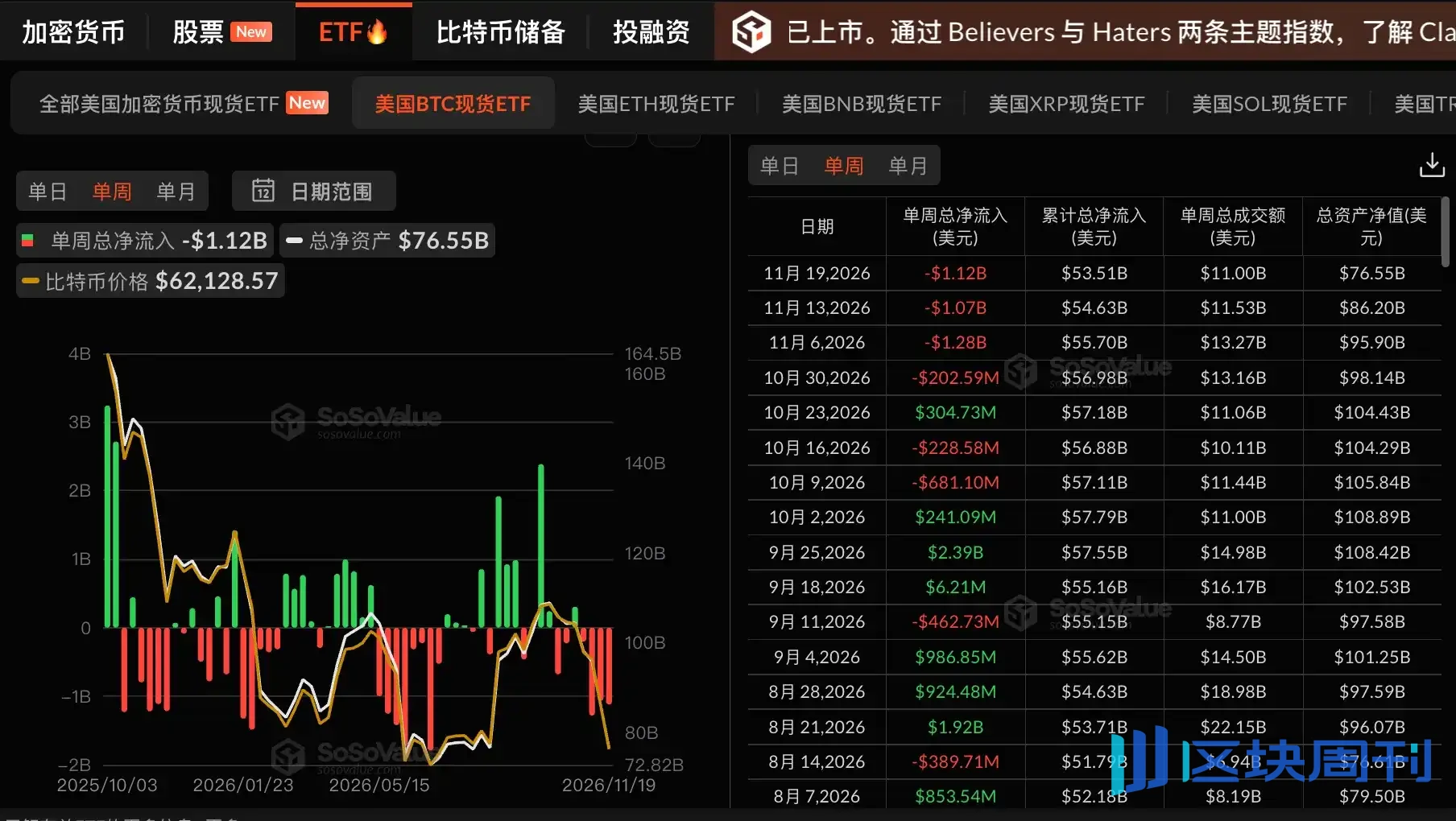
According to SoSoValue data, U.S. spot BTC ETFs saw a net outflow of $582.2 million on November 19; as of the 19th of that month, only the 4th and 16th recorded net inflows, totaling about $82.5 million, while the full-month net outflow had already reached about $3.47 billion; this week alone, spot BTC ETFs have already seen a net outflow of $1.12 billion.
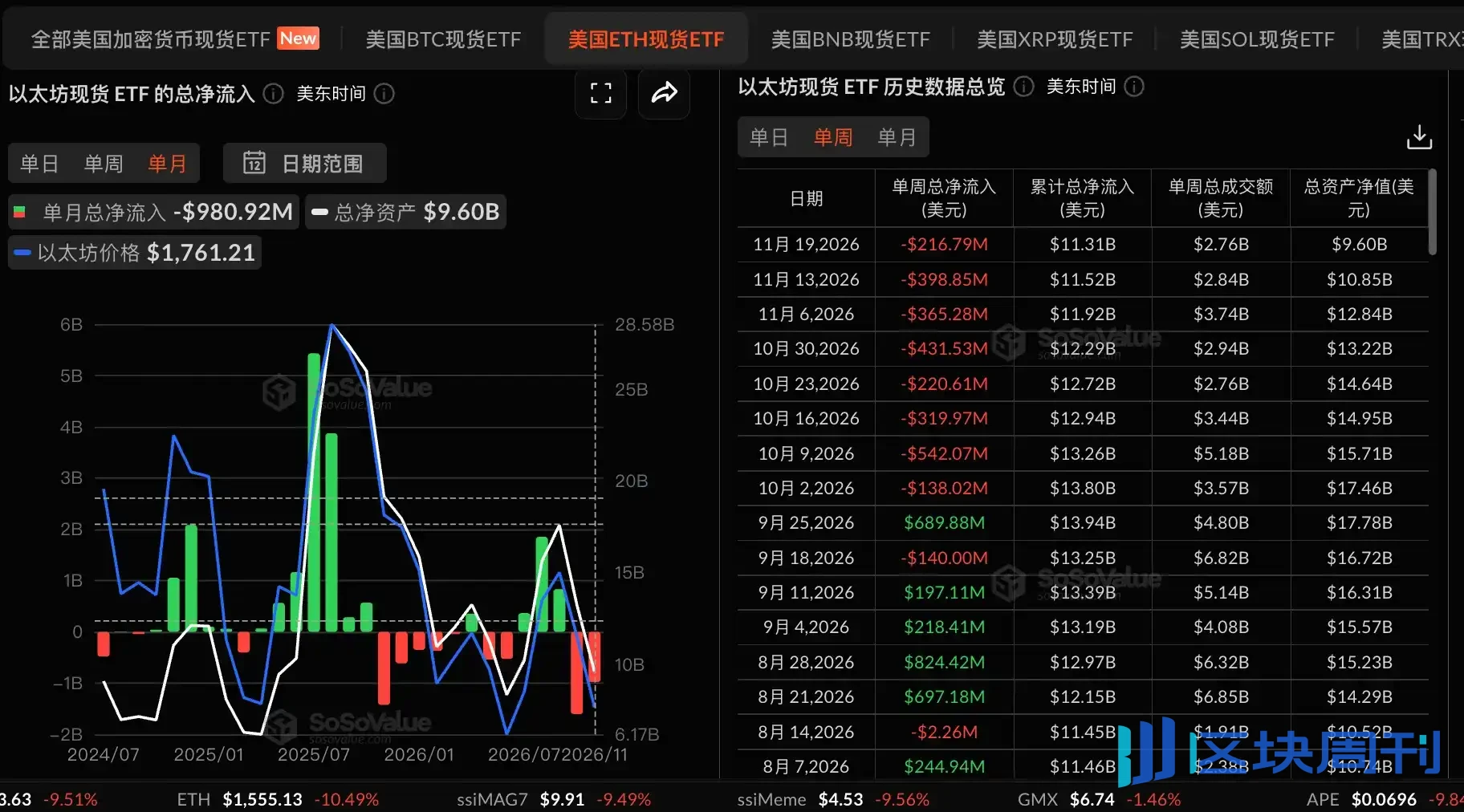
U.S. spot ETH ETF data is likewise not optimistic: its single-month net outflow is close to $1 billion; this week alone, spot ETH ETFs have already seen a net outflow of $216 million, marking 8 consecutive weeks of net outflows.
In terms of institutional appointments, the Democratic Party is still escalating, and Senator Elizabeth Warren, who takes a tough stance on the crypto industry, may become chair of the Senate Banking Committee in 2027, and the bearish factors for the crypto market continue to accumulate.
Crypto Market Data at a Glance: Over $2.4 Billion Liquidated in 24 Hours, BTC and ETH Both Down More Than 50% From All-Time Highs
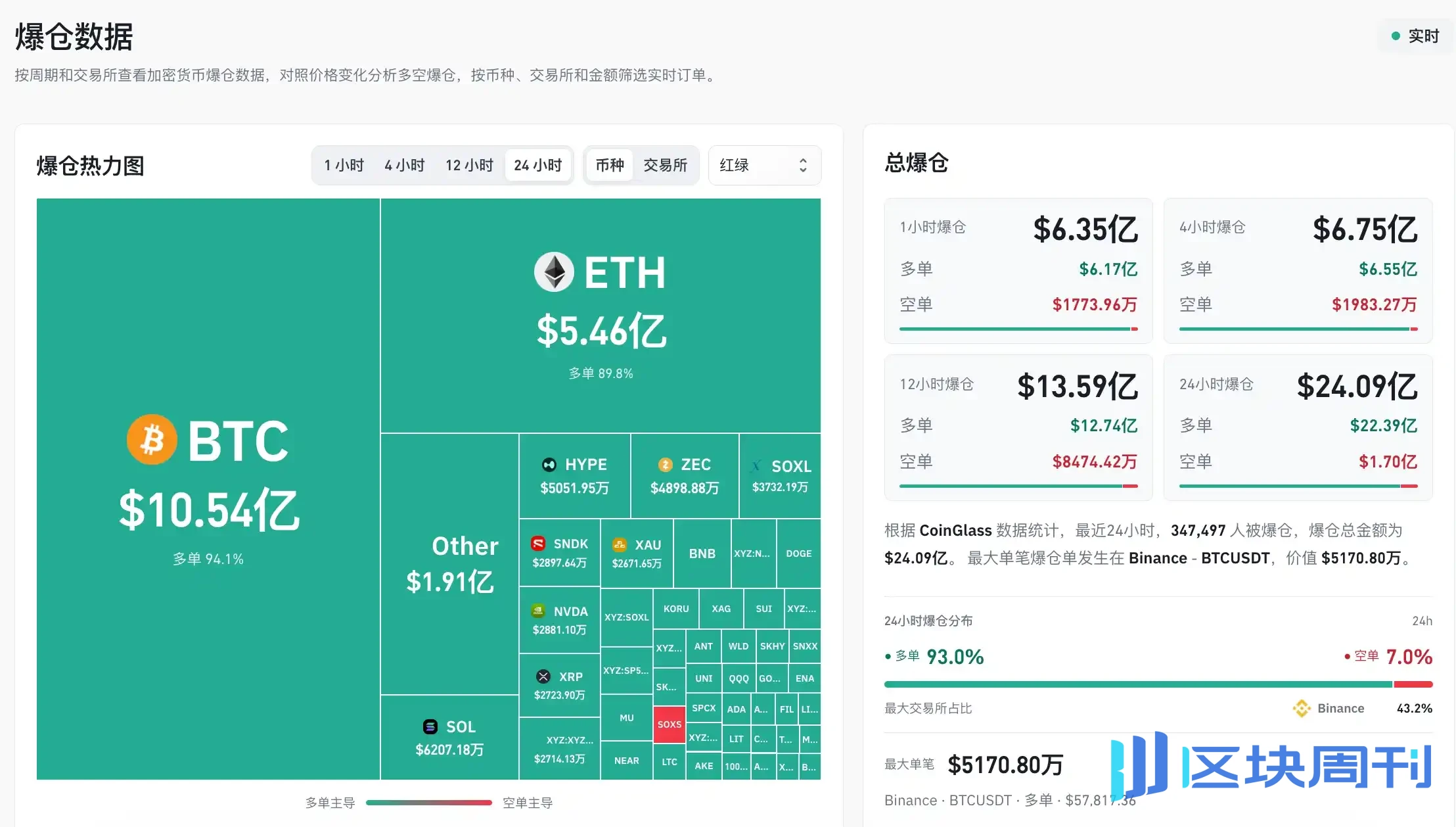
Coinglass data shows that over the past 24 hours, total liquidations across the network exceeded $2.4 billion, with long positions being the main casualties, as long liquidations reached as high as $2.239 billion; BTC liquidations reached as high as $1.054 billion; ETH liquidations amounted to $546 million. And this is clearly not the end point.
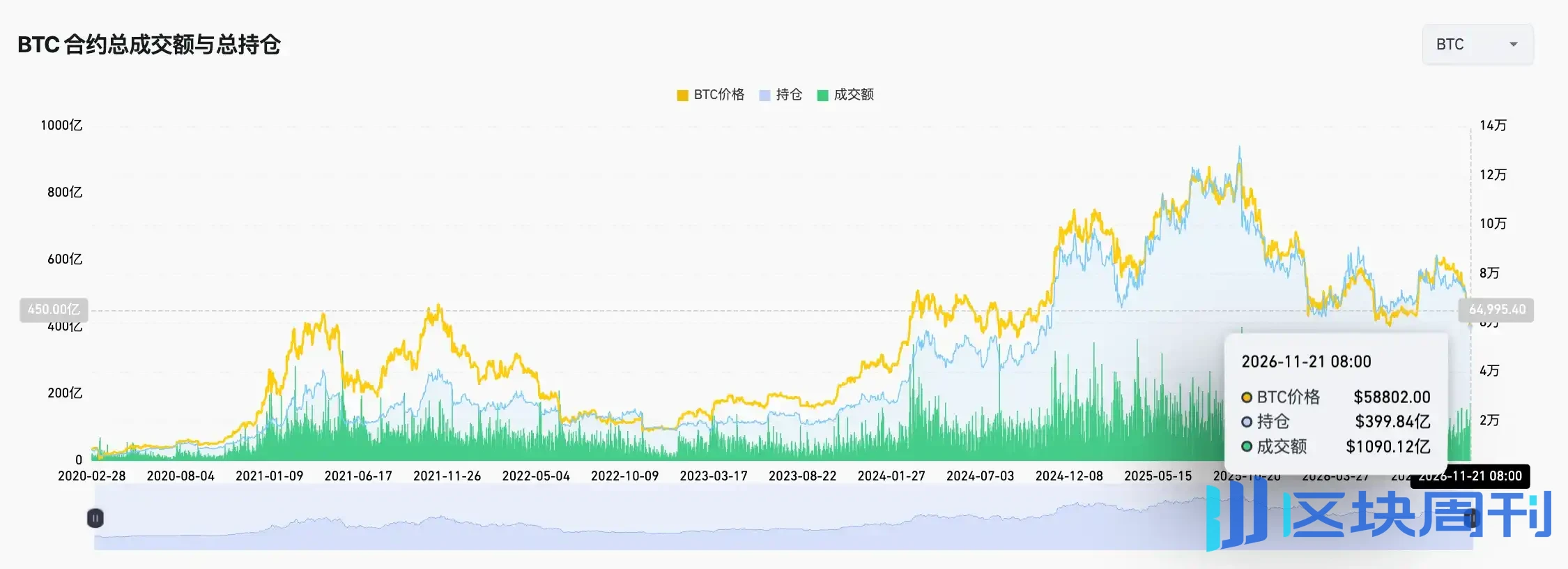
In terms of contract open interest, according to Coinglass data, BTC contract open interest is about $40 billion; the funding rate is -0.0045%, shorts are still continuing to add positions, while leveraged longs are being forced out.
On the spot side, The Block data shows that spot trading volume on centralized exchanges fell from about $1.69 trillion in September to about $1.02 trillion in October, a decline of about 40%; as of November 18, November trading volume was about $450.9 billion, significantly lower than $1.59 trillion in the same period last year.
Looking over a longer time frame, BTC has retraced about 53.8% from the all-time high set in October 2025; ETH has retraced about 67.5% from its all-time high in August 2025; ETH's decline is larger than BTC's, and in the short term the structure remains one in which BTC is relatively resilient while altcoins are being cleared out along with it.
Panic Spreads, Global Stock Markets Wipe Out $9 Trillion in Market Value, Whether There Is an Economic Crisis First Depends on the Magnitude of Fed Rate Hikes
As market concerns over an AI bubble and further U.S. rate hikes heat up, global asset selling intensified further this week, spreading from stocks to precious metals. Since peaking in August, global stock market value has evaporated by nearly $9 trillion.
The Republican Party's defeat in the midterm elections has raised market doubts about U.S. data center construction, and Jensen Huang's sudden resignation has also unsettled investors. The VIX fear index, which measures U.S. stock volatility, rose to 30 on Friday, a new high since late March, but volatility indicators for U.S. Treasuries and major currency pairs remain below recent highs.
Copper prices may post their largest weekly drop since April 2025, while Brent crude remains in the $90 to $94 range. Funds shifted to government bonds, and the U.S. 10-year Treasury yield has fallen 17 basis points so far this week.Gold fell about 1% on Friday, hitting a new low since September 2025, and some investors believe this may reflect that investors are raising cash. The dollar index rose to a 19-month high this week, while the Brazilian real and Israeli shekel fell more than 8% and nearly 5% this month, respectively.
Regarding the future direction of the crypto market, Delphi Digital market strategist Scott Freeman believes: "This isn't just a crypto story or an AI story. It's a liquidity story." (This is not just a crypto or AI issue, this is a story about liquidity.) In his view, the safety cushion provided by liquidity is already very thin, and once something goes wrong, BTC, AI stocks, and gold will be hit on the same day.He worries that financial conditions are tightening while leading growth indicators are weakening, and the Fed may still add rate hikes into this process, with the risk of policy mistakes rising accordingly.
At present, the only thing most worth watching in the short term is the Fed's December policy meeting. If the move is large enough to raise rates by 50 basis points, global capital markets will continue to face further sell-offs.